
Pricing
Four plans. Every fee listed.
All plans use interchange-plus pricing: the card networks’ interchange and assessments pass through at cost, and Triton’s fee — 0.125% of volume plus your plan’s per-transaction fee — appears as its own line on every statement. Pick by how you take payments; the pricing model is the same in all four.
Mobile Business
$39/mo
10¢ per transaction
Guide: to ~$25k/mo
- Free Bluetooth reader
- Interchange-plus
- For payments on the move
Starter
$69/mo
25¢ per transaction
Guide: ~$25k–$60k/mo
- Bring your own terminal
- Interchange-plus
- For low monthly card counts
Deluxe
$99/mo
15¢ per transaction
Guide: ~$60k–$85k/mo
- Bring your own terminal
- Interchange-plus
- Where most practices land
Enterprise
$199/mo
8¢ per transaction
Guide: $85k+/mo
- Bring your own terminal
- Interchange-plus
- For high transaction volume
The dollar guides are how Triton actually sizes plans. Card mix still matters: plan fees move with transaction count (the pure fee arithmetic crosses at 300 and roughly 1,400 transactions a month), which is why an office running 300 transactions at a $10,000 average ticket and a counter running 300 at $35 can land on different plans at the same monthly dollars. The audit reconciles both on your real numbers.
Our markup, in a number. On top of interchange and assessments, which pass through at cost, Triton’s markup is 0.125% of volume on Visa, Mastercard, Discover and debit, and 0.50% on American Express — plus the per-transaction fee listed on your plan above. It is the same percentage on all four plans: moving plans changes the monthly and per-transaction figures, never the percentage. Most processors will not put this number on a public page. It is the one that decides what you pay.
Two fees that aren’t in the plan price. A $15/month gateway fee applies if you key transactions through a virtual terminal — not if you use a physical terminal only. A $3.50/month regulatory product fee is passed through at cost. We list these here because you’d otherwise meet them on your first statement.
And the agreement has a term. Processing runs on a standard three-year merchant agreement. Its early termination fee exists to cover free terminal placement — if you buy your equipment or bring your own, we typically set that fee to $0. Ask before you sign, and the answer goes into the agreement, not into a side promise.
Included in every plan
The list is the same on all four.
Pricing model
Interchange-plus, itemised
Network cost and Triton’s fee on separate lines, every month. No qualified, mid-qualified or non-qualified buckets — and nothing to reclassify.
Fee policy
The plan price does the absorbing
Every merchant account carries fixed monthly platform costs — they’re on every Schedule A in the industry. The plan price is built to absorb them rather than drip them onto your statement, and what’s passed through instead is disclosed above at cost. If a line ever appears that you don’t recognise, call and we’ll explain it.
Operations
Funding and support
Next-day funding on settled batches, 24/7 technical support, and an analytics dashboard for volume and fee tracking.
What interchange is
The cost underneath every processor.
Interchange is what the card networks charge for a transaction — set by Visa, Mastercard, Discover and American Express, not by your processor, and varying by card type and how the card is presented. Every processor pays it. The difference between processors is what they add on top and whether you can see the addition. On interchange-plus, you can: the network’s line and ours are separate on every statement.
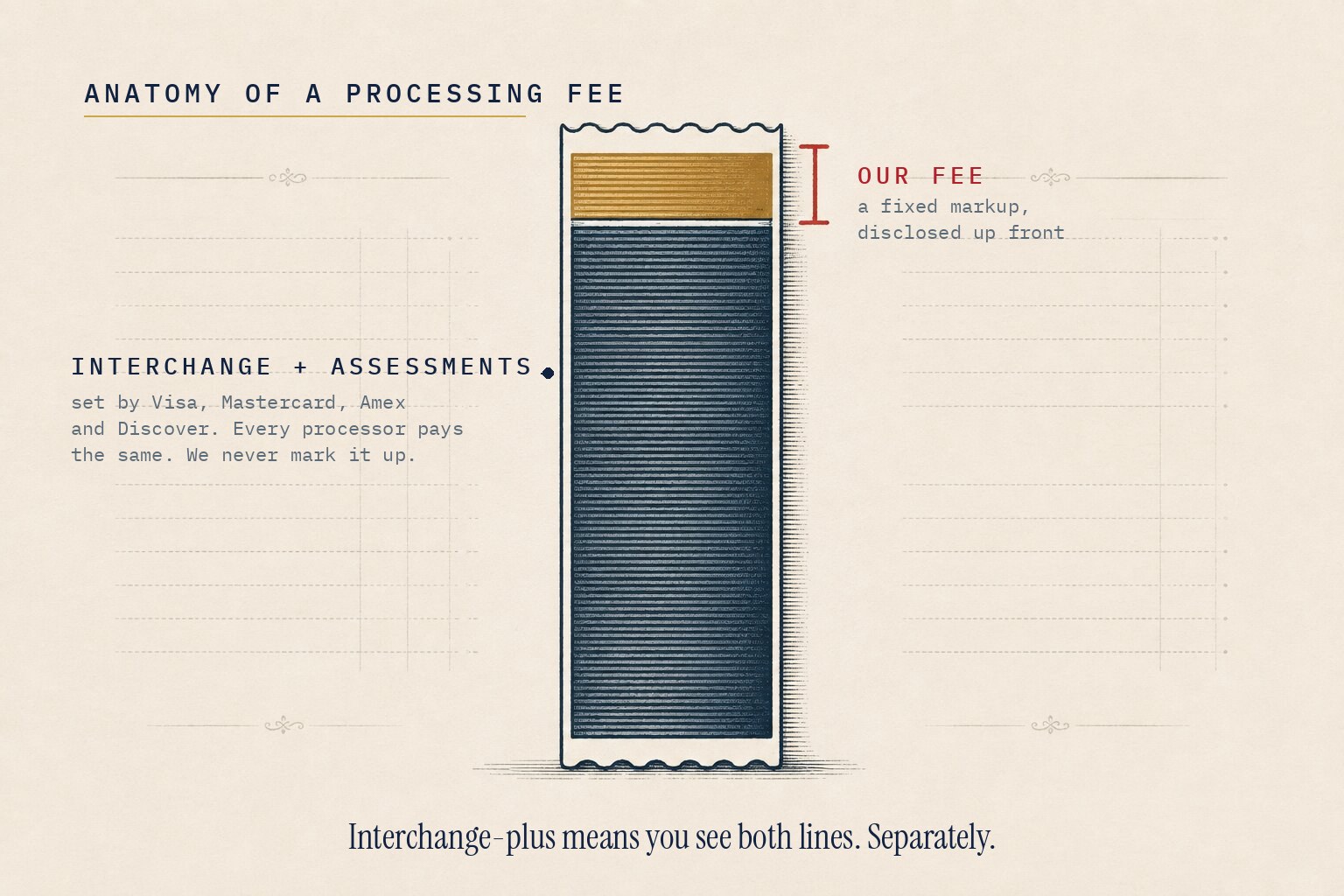
The anatomy of one charge: the network’s share, and ours
Amex, acquired directly
Through OptBlue, American Express settles alongside your other cards — one statement, one deposit — instead of being passed to a third party.
Discover, acquired directly
Same arrangement: Discover volume is priced and settled by us rather than through someone else’s agreement.
Our fee is a line item
We do add a per-transaction fee — that’s the “plus” — and it appears on every statement, next to the network’s cost.
Before you pick a plan
Let the audit pick it for you.
Send one month’s statement and the comparison comes back with the plan that actually fits your volume and ticket size — with the arithmetic shown, next to what you pay today.
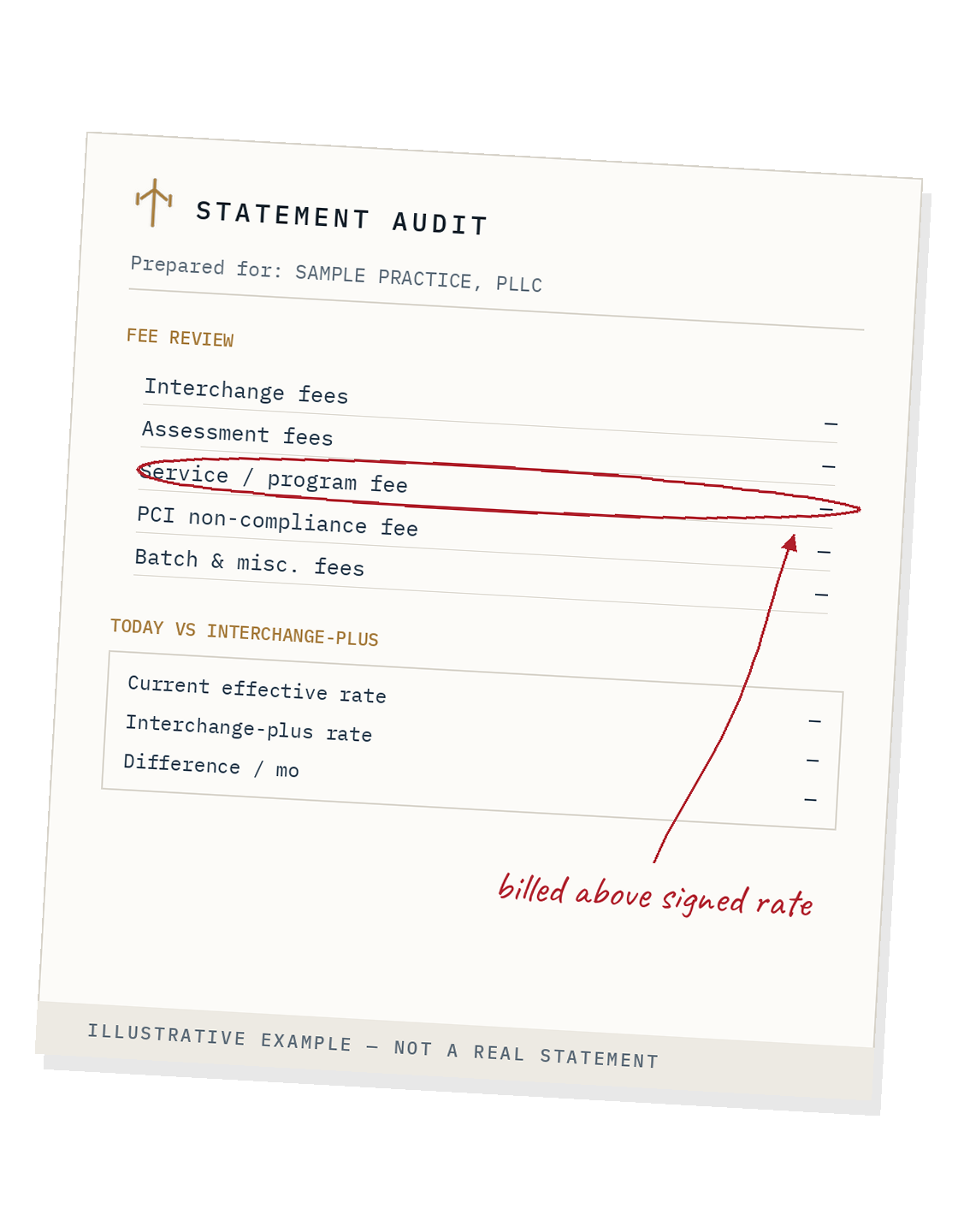
Illustrative example · not a real statement